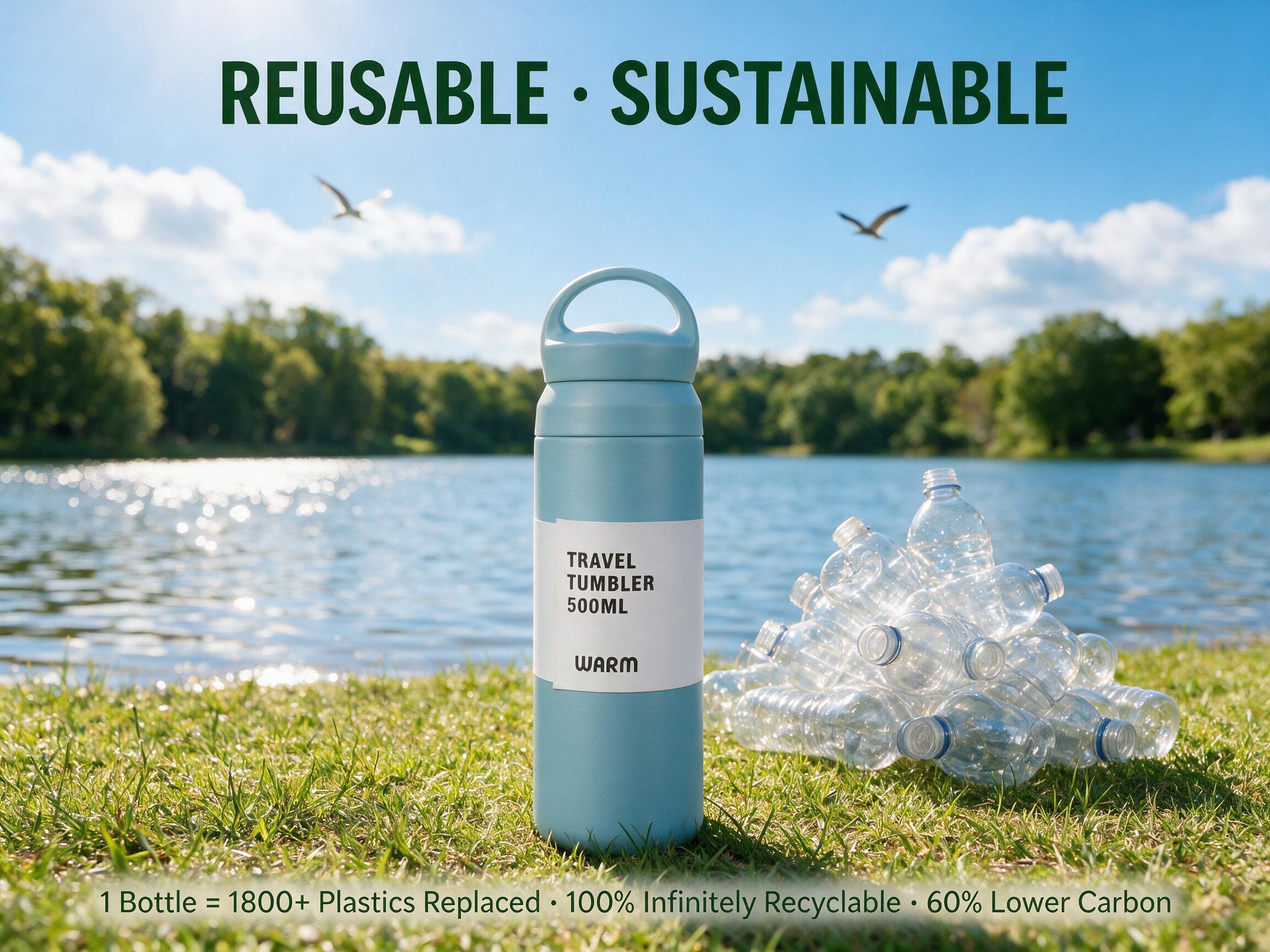
If you've been looking for an environmental change that actually has measurable impact — not just a nice sentiment — switching to reusable drinkware belongs near the top of your list. The data on single-use plastic isn't ambiguous, and the math behind stainless steel reusables is surprisingly straightforward once you dig into it.
The world produces more than 400 million tonnes of plastic every year, and less than 10% of it has ever been successfully recycled. The rest goes into landfills, incinerators, or the environment, where it persists for centuries. A reusable stainless steel bottle won't single-handedly reverse that. But it turns out to be one of those rare consumer choices where the environmental arithmetic is settled and the numbers genuinely justify the switch.
A Problem You Can Actually Measure
We go through roughly 500 billion disposable cups and a trillion single-use plastic bottles every year. A single 500ml PET bottle costs about 100 grams of petroleum equivalent to manufacture, transport, and chill — and the average person uses it for about 12 minutes before throwing it away. That mismatch between the energy poured in and the utility pulled out is the core problem, and it's exactly the problem that reusable drinkware tackles head-on.
Independent lifecycle assessments keep arriving at the same conclusion: a stainless steel bottle needs somewhere between 50 and 500 uses to offset the environmental cost of its own production, with the range depending on what you're comparing it against. For someone who uses their bottle daily, the break-even point arrives within two to twelve months. After that, every refill is a net environmental win. Over a conservative five-year service life, a single bottle displaces more than 1,800 disposable containers.
Why Stainless Steel Wins the Numbers Game
Plastic degrades with every recycling cycle. By the third or fourth pass, those molecules are too degraded for food-grade use, and the material gets downcycled into parking lot bumpers or carpet fiber before eventually heading to the landfill anyway. Stainless steel is different. It can be melted down and reformed indefinitely without losing any of its mechanical or chemical properties. Around 90% of the stainless steel ever produced is eventually recovered and reprocessed, and the recycling process uses roughly a quarter of the energy required for primary production. A bottle at the end of its life doesn't become waste — it becomes raw material for whatever comes next.
The 304 and 316 grades used in food-grade drinkware are especially prized in the recycling stream because their alloy composition is consistent and predictable. That's a real difference from plastic, where mixed resin types and chemical additives turn recycling into an expensive technical headache with marginal economic returns.
The carbon math tells a similar story. A 2023 study by the Danish Environmental Protection Agency tracked the full lifecycle — extraction, manufacturing, distribution, use, and disposal — and found that a steel bottle used daily for a single year produced 60% fewer greenhouse gas emissions than the equivalent volume of bottled water. And the advantage only widened with each additional year of use. Reusables aren't perfect, but they are measurably better, and the margin improves every single time you unscrew the cap.
It's Good for Business, Too
For companies, the case for reusable drinkware goes beyond the environmental spreadsheet. Corporate gifting programs built around branded stainless steel bottles cut down on waste, stretch brand visibility from days to years, and align with the sustainability commitments that customers, employees, and investors increasingly expect. A 2024 Deloitte survey found that 64% of consumers factor a brand's environmental record into their purchasing decisions, and that percentage climbs higher among younger demographics.
Internal programs work the same way. Providing employees with reusable bottles, installing filtered water refilling stations, and eliminating single-use cups from the office delivers measurable reductions in corporate waste streams. More importantly, it signals genuine commitment — the kind people can see and use every day — rather than the vague sustainability pledges that nobody takes seriously anymore.
Making the Switch Without the Headache
For a business that wants to move toward reusable drinkware, the practical steps are less intimidating than they might seem. Start by auditing current usage — quantify how many disposable cups and bottles your organization buys in a year. That number is almost always larger than expected, and having it in black and white makes the business case for yourself and for any stakeholders who need convincing. When you're ready to source, look for 304 or 316 stainless steel from a manufacturer with verified certifications like FDA, LFGB, and REACH, and ask for published material declarations. A reputable supplier will have these ready.
Customization matters more than most people anticipate. Branded bottles in company colors consistently drive higher employee adoption than generic alternatives — people are simply more likely to use and keep something that looks like it belongs to them. On the infrastructure side, installing filtered water stations and hot water dispensers alongside your reusable rollout turns the program from a nice idea into something people will actually use every day. Once things are running, track the reduction in disposable purchases and share those numbers both internally and externally. Concrete results build momentum in a way that mission statements never will.