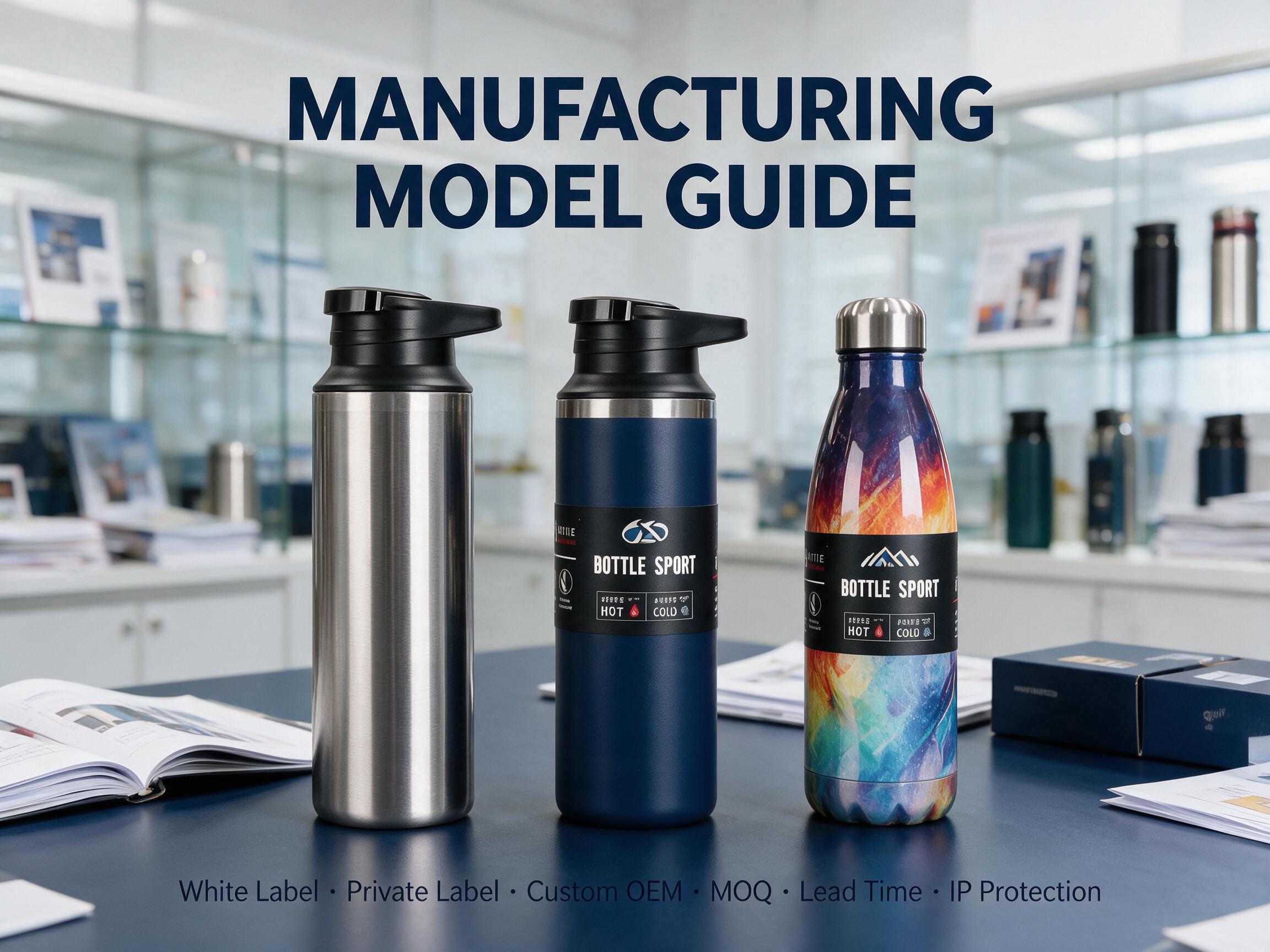
I've had the same conversation at least a hundred times. A buyer reaches out, says they want to "make their own bottle," and I ask the question that usually stops them cold: "Do you mean you want to put your logo on one of our existing bodies, or do you want us to cut a new mold and build something from scratch?"
Nine times out of ten, they haven't thought about the difference yet — and that's completely fine. Most people entering the drinkware space don't realize there are three fundamentally different ways to source a branded bottle, each with its own cost structure, timeline, and risk profile. Once you understand the distinctions, the right choice for your specific situation usually becomes obvious.
Here's how the three models work, what they actually cost in real numbers, and which one makes sense at your stage.
Let's Clear Up What These Terms Mean
The confusion starts with the words themselves, because factories and buyers often use them differently. Here's how we define them at Moin, and it matches what most established drinkware manufacturers in the supply base use.
White Label is the simplest model: the factory makes a standard product — say, a 20 oz straight-wall tumbler in matte black — and ships it to you unbranded. No logo, no custom packaging, sometimes not even a retail box. You handle the decoration yourself, whether that means laser engraving in your own shop or sending the blanks to a local screen printer. The same body goes out to dozens of other buyers that same month. It's fast, it's cheap per unit, and there's zero exclusivity.
Private Label takes that same standard body but keeps the decoration at the factory. Your logo gets laser-engraved or screen-printed on our production line, your packaging goes on before it leaves the building, and the finished product arrives at your warehouse shelf-ready. You still don't own the mold for the body itself, but you control the entire branded presentation. Most factories will agree not to run the exact same color-plus-decoration combination for another buyer for 90 to 180 days, but the underlying body shape remains available to anyone.
Custom OEM — and its close cousin ODM, Original Design Manufacturing — is the full-build option. You either bring your own design or co-develop one with the factory, and new tooling gets cut for the body, the lid, or both. You own the mold by contract, which means you can prevent the factory from selling that shape to anyone else for the life of the agreement. This is how Stanley, Owala, and BrüMate got their signature silhouettes — none of those shapes existed in a factory catalog before someone commissioned the tooling.
The Numbers That Actually Matter
Let's put some real figures on these models, using a typical 20–24 oz stainless steel bottle as our reference. Exact numbers shift with alloy choice, surface treatment, and seasonal factory loading, but these ranges are what you should expect in a quote.
On MOQ, White Label starts as low as 100 pieces — you can literally order a pallet. Private Label typically requires 300 to 1,000 pieces because the factory needs to justify setting up the decoration line. Custom OEM jumps to 5,000 to 10,000 pieces, because nobody is going to cut a mold for a 500-piece order.
Lead times follow the same pattern. White Label ships in 7 to 15 days since the bodies are sitting in finished-goods inventory. Private Label takes 15 to 25 days — the extra week or so covers decoration setup, strike-off approval, and packaging integration. Custom OEM runs 45 to 75 days from order confirmation, with 30 to 45 of those days consumed by mold fabrication and prototype rounds before mass production even begins.
The cost comparison holds a couple of surprises that catch first-time buyers off guard. Using White Label as the 1.00x baseline, Private Label only adds 5 to 20 percent — and that's including the decoration you'd have paid for anyway. If you were going to send those White Label blanks to a local engraver, Private Label usually comes out cheaper when you factor in domestic freight and double-handling. Here's the bigger surprise: Custom OEM at matching volume can actually run 0.90 to 1.15x versus the White Label baseline, because a dedicated tooling line is more efficient than repurposing a standard body across multiple customers. But — and this is a heavy "but" — OEM only gets cheaper at volume. The conservative threshold is 5,000 pieces per SKU per order. Below that, the mold amortization kills your unit economics.
Tooling fees for OEM range from $1,500 to $8,000 depending on part complexity, and most factories will amortize that against a committed volume threshold if you negotiate it. There's no tooling cost at all for White Label or Private Label — you're using molds that already exist. On exclusivity: White Label offers none. Private Label gives you a short window — 90 to 180 days — on your specific decoration combination. Custom OEM, with buyer-owned tooling, gives you full shape-level exclusivity for the life of the mold, typically 3 to 5 years or 300,000 pieces. That's the lever that justifies the upfront investment for most brands. Decoration options scale accordingly — White Label leaves it all to you, Private Label gives you every in-factory process available, and OEM adds custom surface textures, color-matched powder coat, and custom geometry on top of everything else.
Why Most Growing Brands Land on Private Label
At Moin, Private Label accounts for the majority of our orders, and the reason is straightforward: it gives you complete branded control with almost no additional risk. You get your logo applied in our factory, your packaging integrated into the production line, and your UPC codes and hangtags placed before the goods leave the building. The finished product arrives at your warehouse ready for the shelf or the fulfillment center.
This model fits a wide range of buyers. Gym chains and yoga studios ordering 300 to 2,000 pieces with a clean laser-engraved logo. Promotional distributors managing corporate gifting programs for dozens of end-clients. Startup DTC brands on their first or second production run, not yet ready to commit to custom tooling. Retailers with house brands who need a consistent SKU across their store network but don't yet have the volume to amortize a mold.
There are two advantages to Private Label that nobody talks about enough. The first is packaging integration — because decoration and packaging happen on the same line, your goods ship shelf-ready. No receiving a pallet of blanks, unboxing them, decorating them at a third party, re-boxing them, and hoping nothing gets scuffed in the process. The second is batch traceability. Since the factory handles the full production, any quality issue can be traced back to a specific production lot. That matters enormously when you're selling to a retail chain that requires lot-level recall capability.
Now, White Label does have its place. If you're an Amazon reseller who decorates in your own warehouse to keep FBA turnaround fast, or a local engraving shop that orders blank bodies by the pallet, or someone running a trade-show program under 300 units — White Label is the right call. The common mistake is choosing White Label when you don't have in-house decoration capacity. If you're going to pay a third-party printer or engraver after receiving the blanks, your total landed cost — blank body plus domestic freight plus decoration plus re-packaging — almost always exceeds a single Private Label PO. The rule of thumb is simple: if you don't own a laser engraver or a screen print shop, and you're ordering more than 300 units, skip White Label and ask for a Private Label quote.
When It's Time to Go Custom
Custom OEM is the biggest commitment and the biggest potential payoff. You should seriously consider it when at least one of these conditions is true: you're selling 5,000-plus pieces per SKU per order and plan to repeat that SKU for at least three years (that's roughly the break-even on a $1,500 to $8,000 mold, and most factories will amortize the tooling fee against a committed volume threshold); your brand's value proposition depends on a physical feature no stock body offers — a custom grip pattern, a proprietary lid interface, a tapered base for a specific car cup holder, or a particular neck diameter for a compatible filter; or you need enforceable shape-level exclusivity that no decoration-only Private Label contract can provide. For major retailers launching a category-exclusive SKU, the ability to block competitors from listing the same shape on Amazon or other channels directly justifies the tooling cost.
The trap to watch out for is rushing the sampling phase. I've seen buyers approve a first-article sample based on photos, only to discover a 2 mm thread mismatch that causes leaks, a lid gasket that tears on the fifth open, or a center-of-gravity problem that makes the bottle tip over on a desk. Experienced buyers always run at least two, preferably three, full-functional prototype rounds. That means drop tests, leak tests, and 200-cycle lid durability before signing off for mass production. The extra $2,000 in sampling costs routinely prevents a $100,000 lot rejection.
If you do go the OEM route, get the paperwork right on three specific points — do not rely on handshake deals, no matter how long you've known the factory owner. First, mold ownership: you pay the mold fee, the contract states the mold is your property, and there's a clear written process for releasing it if you ever move production. Factory-owned molds sound cheaper upfront, but they mean the factory can run your exact shape for a competitor after your first order. Moin typically charges a nominal annual storage fee of $1 to $500 for buyer-owned molds. Second, exclusivity period: for Private Label, 90 to 180 days from first ship date on the decoration combination is industry standard. For OEM, exclusivity should cover the full useful life of the mold — typically 3 to 5 years or 300,000 pieces — on the specific shapes in the mold bill of materials, not just your decoration. Third, what happens to your IP at end of life: the contract should require the factory to return or destroy first-article samples, 3D CAD STEP files, and rejected production units rather than keeping them as reference samples for other customers. For buyers without an in-house legal team, Moin provides a standard memorandum of understanding covering these three points; have a local attorney review it for the jurisdiction you want disputes resolved under.
How a Project Actually Runs at Moin
Transparency on process matters, so here's what a typical engagement looks like from inquiry to delivery. Days 1 through 3, we prepare your quote based on target MOQ, the model you've chosen, your target market (this determines compliance scope), and any reference artwork or drawings you can provide. Days 3 through 5, you get a pre-production sample — a plain stock body for visual reference, or a photo render if you're going OEM. For Private Label orders, days 5 through 10 cover decoration strike-off: we laser, print, or engrave a sample on the exact body and color so you can approve ink match, depth, and placement before production begins. For OEM, days 30 through 50 are mold fabrication and sampling — T1 sample, your review, minor mold revision, T2 sample, then signoff. Mass production runs 15 to 25 days for Private Label and 45 to 75 for OEM including tooling. Once production wraps, final inspection, booking, container loading, and shipping documents all happen within a week, and for most FOB orders you'll have your packing list, commercial invoice, bill of lading, and test reports within 48 hours of departure.
One piece of advice I give every new customer: even if your endgame is OEM, start with a small Private Label or White Label pilot order first. Running one real production cycle gives both sides the operational history to quote OEM timelines accurately, and it gives you 90 days of actual sales data to size your OEM commitment with facts instead of spreadsheets. The knowledge gain from that single pilot pays for itself in a more accurate OEM quote every time.