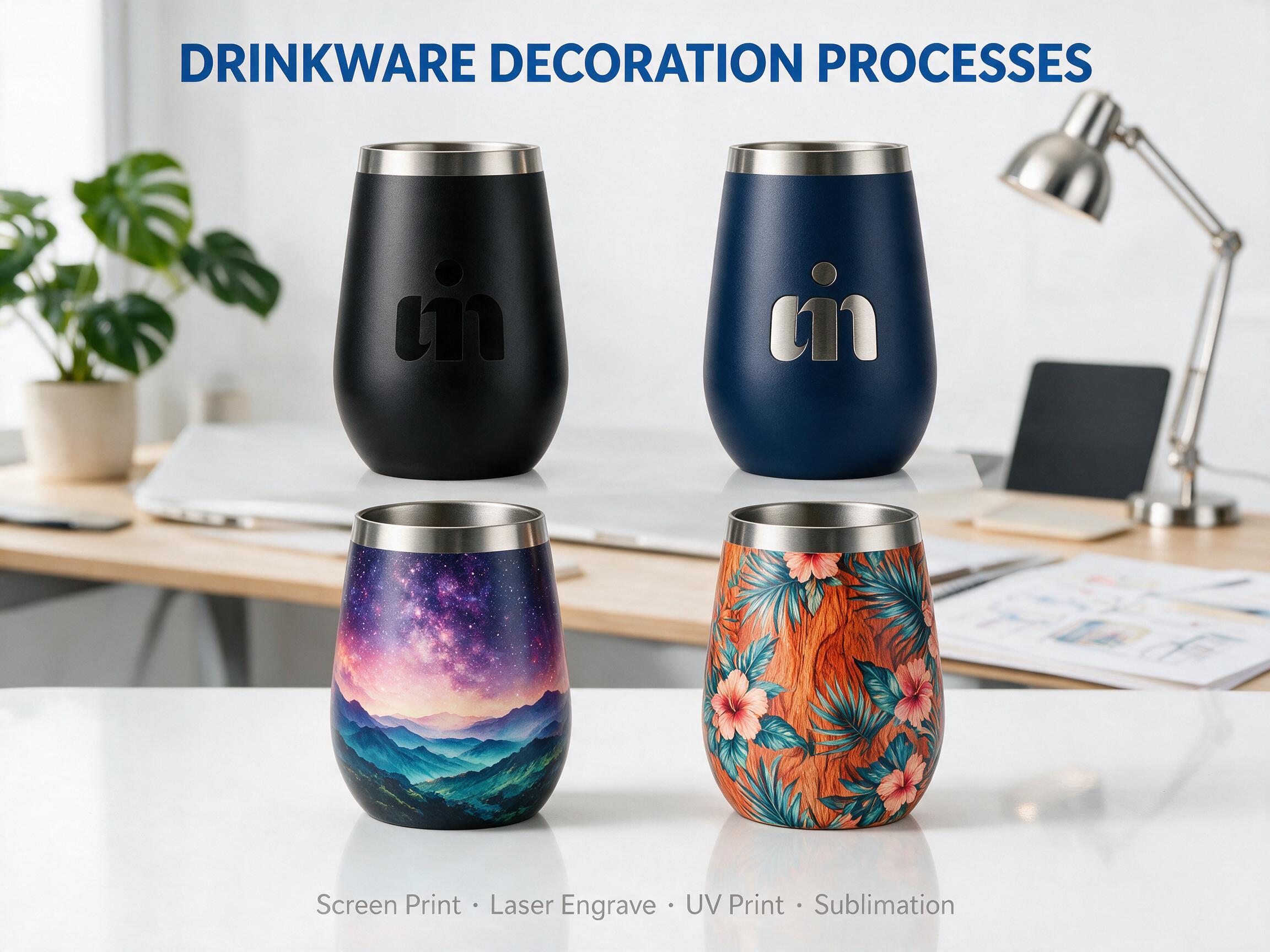
The first time I walked a client through decoration options, they stared at the sample board for about thirty seconds and said, "I just want my logo on the bottle. Why are there four different ways to do that?"
Fair question. The decoration process you choose for a stainless steel bottle determines more than just how the logo looks — it sets your minimum order quantity, your per-unit cost, how long the mark lasts after six months of daily use, and what kind of customer the finished product actually speaks to. A screen-printed logo on a $6 promotional giveaway and a laser-engraved mark on a $45 corporate gift are technically both "branded bottles," but they're completely different products aimed at completely different buyers.
Let me walk through the four processes we use at Moin, what each one costs in practice, and — most importantly — which business model each one actually serves.
Meet the Four Decoration Processes
Each of these works on a fundamentally different principle, and that principle dictates what's visually possible and what it costs.
Screen printing pushes ink through a mesh stencil onto the bottle surface, one color at a time, then cures it with UV light or heat. It's the workhorse of the industry — fast, cheap, and perfect for bold one-to-three-color logos on flat or gently curved surfaces. It cannot do gradients, photographs, or fine text below about 6 point.
Laser engraving uses a focused beam to remove the powder coat and expose the bare stainless steel underneath. There's no ink involved, so there's nothing to fade, scratch off, or wash away. The mark is literally part of the metal. The trade-off: you get exactly one "color" — metallic silver against whatever powder coat you chose.
UV digital printing is essentially an inkjet printer for curved surfaces. CMYK plus white ink gets deposited directly onto the bottle in a single pass, no screens or films needed. If your design has gradients, photography, or more than three colors, UV is probably your answer.
Heat sublimation prints special ink onto transfer paper, then heat-presses it onto a bottle that's been pre-coated with a polyester-based white coating. The ink turns to gas under heat and bonds permanently into the coating. The result is a high-resolution photograph wrapped edge-to-edge around the bottle. The catch: it only works on white or very light-colored sublimation-ready coatings.
Screen Print and Laser: The Two You'll Reach for Most
If I had to guess, eighty percent of the orders we process at Moin use one of these two methods. They sit at opposite ends of the cost spectrum but together cover most real-world use cases.
Screen printing is what you want when volume is high and unit cost is the priority. Supermarket buyers running private-label SKUs at 3,000 to 10,000 pieces per order. Promotional distributors doing conference swag at 500 to 2,000 pieces. Event organizers — marathons, festivals, cycling events — who need 1,000 to 5,000 branded bottles in two to three weeks with a simple one- or two-color logo. School and university programs ordering 500 to 3,000 pieces with a crest or mascot. The MOQ for screen print sits around 300 to 500 pieces, and a one-color design keeps it as cheap as it gets. Adding a second or third color tacks on 15 to 25 percent per color, so simplifying the logo to a single color before quoting can cut decoration cost by 30 to 40 percent. Setup takes one to two days for mesh preparation, and the ink holds up for 200 to 500 dishwasher cycles before visible fade — fine for giveaways and retail products, just don't expect it to survive years of daily washing unchanged. Screen print can't reproduce gradients, photographs, or text below 6 point, and multi-color registration on curved surfaces has a 1 to 2 mm tolerance, which works for bold logos but not for fine art.
Laser engraving is where you go when permanence and perceived quality matter more than saving fifty cents a unit. The MOQ drops to 100 to 300 pieces, setup takes half a day from a digital file, and the unit cost is only 0 to 20 percent above screen print for a result that reads as premium at retail. Corporate gifting programs — Fortune 500 employee gifts, executive welcome kits, client appreciation — are the natural home for laser, typically at 200 to 2,000 pieces. Premium retail brands selling through boutique fitness or specialty coffee channels at $25 to $50 retail. Real estate and financial services firms ordering closing gifts at 100 to 500 pieces per batch, often with individual personalization. Golf clubs, wine clubs, alumni associations — anywhere exclusivity is part of the value proposition. The limitation is straightforward: you can't get a specific Pantone color from bare steel. If your brand requires a colored logo, the workaround is two-stage decoration — screen print the color logo, then laser-engrave a name, serial number, or date in a second pass. It adds 1.5 to 2x to decoration cost but produces a genuinely premium result that a single process can't touch. If the budget allows laser at all, choose it over screen print — the perceived quality uplift at a cost premium of only 0 to 20 percent is the single best decoration dollar you can spend.
Going Full-Color: UV and Sublimation
When the design itself is the product — not just a logo on a product — these two processes are where you look. They each unlock a different kind of visual possibility, and each comes with trade-offs worth understanding up front.
UV digital printing is the more versatile of the two. A digital file — photograph, illustration, gradient, or complex multi-color logo — prints directly onto the bottle in one pass with no screens or films to set up. MOQ runs 200 to 500 pieces, setup takes half a day, and the unit cost runs 1.5 to 2.0x the screen print baseline. This is the go-to for brand operators and DTC startups launching a lifestyle drinkware line where the bottle surface carries original artwork, typically at 500 to 3,000 pieces per SKU. Coffee roasters co-branding tumblers with label-style designs that match their packaging. Creative agencies producing limited-edition merchandise for client campaigns where visual impact matters more than per-unit cost. The honest limitation: UV ink sits on the surface rather than bonding into it, which makes it the least durable option under repeated dishwasher exposure. Expect visible edge wear after 150 to 300 cycles compared to 300 to 500 for screen print. For retail products destined for daily dishwasher use, request a dishwasher test sample before committing to production, and make sure the end customer knows hand washing is recommended. One nice upside: UV has no per-color setup cost, so a ten-color design costs roughly the same as a one-color design. If your artwork uses four or more colors, UV is often cheaper than multi-color screen print at volumes under 2,000 pieces.
Heat sublimation fills a unique niche: small-batch, full-color personalization that no other process can economically match. The bottle must be specified as sublimation-ready with a white polyester-based coating, which limits you to light-colored backgrounds. MOQ runs 500 to 1,000 pieces for production runs, though the process uniquely supports single-unit orders for custom gift shops — wedding favors, birthday gifts, team gifts with photos and names. Sports teams and leagues produce fan merchandise with player photos and championship graphics at 500 to 2,000 pieces per run. Tourism brands — national parks, cities, resorts — sell souvenir bottles with scenic photography. Unit cost runs 1.3 to 1.8x baseline, and transfer paper setup takes 1 to 2 days. The finish is essentially a high-resolution photograph wrapped edge-to-edge around the bottle, with 200 to 400 dishwasher cycles of durability. The limitations are real, though: the sublimation coating is slightly less scratch-resistant than standard powder coat, and colors can yellow under prolonged UV exposure — a bottle left in a sunny car for months will show it. For these reasons, sublimation works best in gift and specialty channels rather than rugged daily-use programs.
When One Process Isn't Enough
Some of the most effective branded drinkware we produce uses two decoration processes on the same bottle to get the best of both worlds. The combinations we see most often: screen print the color logo, then laser-engrave an individual name or date below it — perfect for corporate award programs where every bottle is personalized but shares a common brand mark. UV print full-color artwork with a laser-engraved accent line or secondary logo, popular with premium DTC brands that want both visual richness and a tactile metallic detail.
Two-process decoration adds 10 to 20 days to lead time and 1.5 to 2.5x to decoration cost, so it's not for every program. But for buyers targeting the $35-plus retail tier or high-end corporate gifting, the result justifies the investment — you get something no single process can produce.
So Which Process Fits Your Business?
If you're a supermarket or mass-retail buyer running private-label SKUs above 3,000 pieces with cost sensitivity as your top concern, screen print in one or two colors on a stock body is almost certainly your answer. If you're managing corporate gifting or executive programs at 200 to 2,000 pieces where premium feel matters, laser engraving is the safe default — optionally combined with screen print if you need a colored logo. Promotional distributors and event giveaway programs at 500 to 5,000 pieces with fast turnaround should stick with one-color screen print on a single-wall body to hit the price point.
Brand operators and DTC lifestyle lines at 500 to 3,000 pieces where the design leads the product should look at UV digital printing for full-color artwork. Custom gift shops and personalization businesses at 1 to 200 pieces with photo or personal content need heat sublimation on a white-base sublimation-ready bottle. And if you're targeting the $35-plus premium tier at 1,000-plus pieces and want a signature look, two-process decoration — UV plus a laser-engraved accent — is where you should be looking.
The decoration process isn't a finishing detail. It's the decision that determines what kind of brand presence the bottle carries, how long that presence lasts, and what tier of customer it speaks to. Match the process to your business model and your end-user's actual daily experience, and the same steel bottle becomes a fundamentally different product.