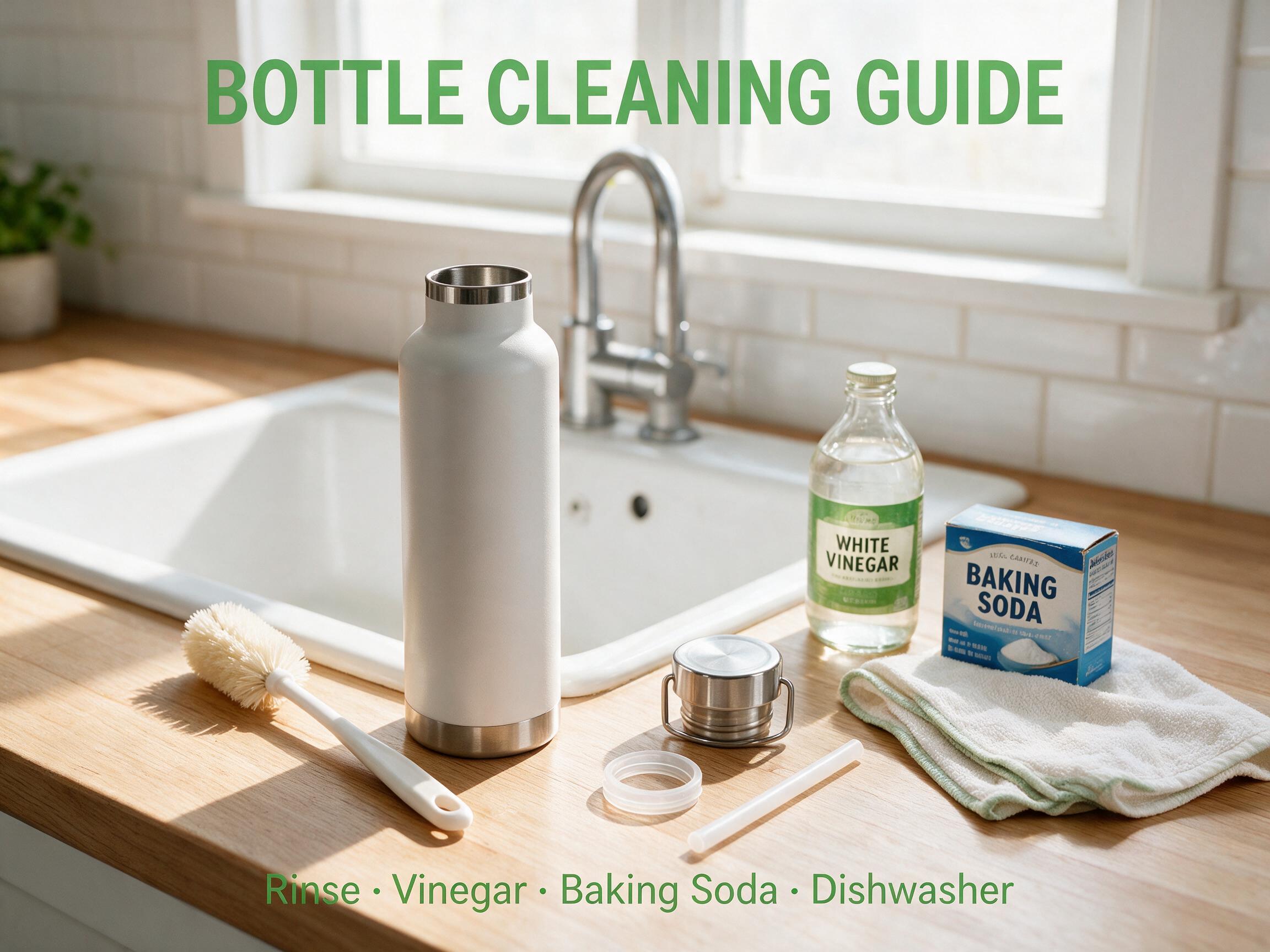
Most people don't think about cleaning their water bottle until it starts to smell. By then, you're already behind. A reusable stainless steel bottle can easily last five to ten years, but only if you give it a few minutes of attention each week. The good news is that everything you need — soap, vinegar, baking soda — is already sitting in your kitchen.
The thing that catches people off guard is just how fast bacteria builds up. Every sip transfers mouth bacteria to the rim and lid. Add warmth and trapped moisture, and the inside of your bottle becomes a surprisingly effective incubator. Laboratory tests have found unwashed reusable bottles holding over 300,000 colony-forming units per square centimeter — a number that surprises most owners when they hear it.
For most healthy adults, this level of bacteria isn't dangerous. But it does explain that musty smell, and it's probably behind the occasional stomach irritation that long-time bottle users sometimes mention. The fix isn't complicated — it's just a consistent routine.
Your Bottle Is Dirtier Than You Think
That 300,000 CFU figure comes from a study published in the Annals of Civil and Environmental Engineering, where researchers tested bottles that had gone a full week without cleaning. What makes reusable bottles such effective bacteria habitats is the dark, warm interior combined with constant moisture from whatever you're drinking. You can't see biofilm forming along the bottom seam, but it's there — and it builds up faster than most people realize.
There's no magic number for how often you should clean your bottle. If you only drink plain water, a quick daily rinse might be enough for a few days. If you're filling it with coffee, tea, sports drinks, or anything with sugar, you should wash it after every use. The methods below cover every scenario, from a two-minute daily habit to a once-a-week deep clean.
The Everyday Clean
The simplest routine is also the one that prevents most problems before they start. After you finish your drink, rinse the bottle with warm water and a few drops of mild dish soap. Use a long-handled soft-bristle brush to scrub the bottom — that's where sediment and biofilm tend to settle. Rinse until there's no soap residue left, then store the bottle upside down on a drying rack with the lid off.
This takes about a minute and keeps odors and stains from ever getting a foothold. It also extends the life of your gaskets and any exterior coating by preventing the acidic buildup that comes from leaving residue sitting for days.
When Plain Soap Isn't Enough
For a weekly deep clean, white vinegar is hard to beat. Its mild acidity dissolves the mineral deposits that build up from tap water, neutralizes alkaline odors, and kills a broad range of bacteria — all without the harshness of bleach or chemical cleaners.
- Fill the bottle about one-fifth full with undiluted white vinegar.
- Top it off with warm water and let the solution sit for 15 to 30 minutes.
- Scrub the interior with a soft brush, paying extra attention to the threads where the lid screws on.
- Rinse at least three times with clean water and let it air dry completely.
If you catch a faint vinegar smell after drying, don't worry — it disappears within an hour. This method is completely safe for 304 and 316 stainless steel interiors and won't affect vacuum insulation.
For the stains that vinegar won't touch — coffee rings, tea residue, stubborn smoothie marks — baking soda is your next move. Mix two tablespoons of baking soda with just enough warm water to form a paste. Spread it across the interior with a soft brush, work it into the surface gently, and let it sit for about 15 minutes before rinsing. The mild abrasive action lifts residue without scratching the steel.
If you're dealing with a really persistent odor, try combining baking soda with a splash of vinegar. The fizzing reaction helps dislodge embedded gunk from the crevices around the base seam where brushes sometimes can't reach.
What About the Dishwasher?
Many powder-coated stainless steel bottles carry a dishwasher-safe label for the top rack, and for basic cleaning, this works. But there are trade-offs worth knowing about. High-temperature drying cycles will slowly degrade printed logos over repeated cycles, and the heat and detergent combination accelerates wear on silicone gaskets. If you go the dishwasher route, place the bottle upside down on the top rack, remove the lid and gasket for separate hand washing, and skip the heat-dry setting.
For any bottle with a printed logo, powder coating, or a vacuum insulation rating you want to preserve, hand washing is still what manufacturers recommend. It's gentler on every component and only takes a couple of minutes.
Lids, Gaskets, and When to Call It Quits
The lid assembly is where most of the bacterial action happens, and it's also the part people clean the least. Silicone gaskets, sliding mouthpiece covers, straw valves — these all trap moisture and organic matter far more effectively than the smooth bottle interior. Once a week, take every removable component apart and soak them in warm soapy water for ten minutes. A cotton swab or a small brush will get into the grooves where the gasket sits. Don't reassemble anything until every piece is bone dry.
Even with good care, bottles don't last forever. You'll know it's time to replace yours when the vacuum insulation stops working and the exterior turns hot or cold to the touch. Cracked or warped silicone gaskets that no longer seal are another clear sign. If you notice pitting, rust spots, or a metallic taste that won't go away no matter how thoroughly you clean, the interior has degraded. And dents near the base can compromise the double-wall structure — even if they look minor from the outside.
The good news is that with the routine described here, a quality bottle will give you years of trouble-free use. The difference between a bottle that lasts a decade and one you quietly throw out after a season comes down to a few minutes of weekly care.